
Best Volleyball Training Machines
Volleyball training machines fall into two distinct categories. Serving machines fire or feed balls across the net at adjustable speed, spin, and trajectory, giving you a repeatable stream of reps for serve receive, digging, and attacking. Spike trainers hold the ball stationary at a set height in the hitting window so players can work on approach mechanics, arm swing, and contact without a setter or tosser. The two categories solve different training problems, and programs with larger budgets often run both.
At the top of the serving machine market, Sports Attack makes the Total Attack: a three-wheel machine capable of 90 MPH, side-spin jump serves, and a release point up to 9’6″. It is sold only through specialty retailers such as sportsattack.com and AllVolleyball, with no Amazon listing. The eight machines reviewed here cover the full range below that level, from portable auto-feed units to the flagship Sports Attack machines used by hundreds of college programs.
Six of the picks are serving machines: the Skill Attack, the Attack (Men’s), the Attack II (Women’s), and three Volleyball Tutor models ranging from budget AC-powered to battery-operated. The final two are Edge Pro spike trainers, a category that was absent from the original version of this post and from most training machine roundups written before 2019.
Quick Picks
| Role | Product | Buy |
|---|---|---|
| Best Overall | Attack II Volleyball Machine (Women’s) | Check on Amazon → |
| Best Budget | Edge Pro Volleyball Trainer (Travel/JV Pack) | Check on Amazon → |
| Best Premium | Attack Volleyball Training Machine (Men’s) | Check on Amazon → |
At a Glance
| Product | Best For | Category | Power | Buy |
|---|---|---|---|---|
| Skill Attack Volleyball Machine | Youth and high school programs | Serving Machine | AC | Amazon → |
| Attack Volleyball Training Machine (Men’s) | Men’s and co-ed programs | Serving Machine | AC | Amazon → |
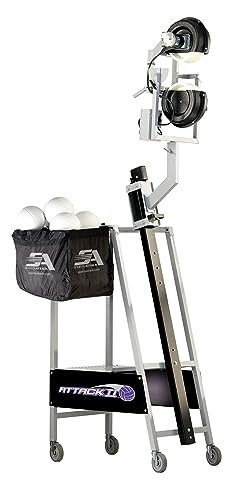
| Attack II Volleyball Machine (Women’s) | Women’s and girls’ programs | Serving Machine | AC | Amazon → |
| Volleyball Tutor Gold Model | Budget auto-feed, school teams | Serving Machine | AC | Amazon → |
| Volleyball Tutor Silver Pro Model | Mid-range AC with spin control | Serving Machine | AC | Amazon → |
| Volleyball Tutor Black Model | Outdoor and no-outlet locations | Serving Machine | Battery | Amazon → |
| Edge Pro Volleyball Trainer (Independent) | Team spike mechanics training | Spike Trainer | No Power | Amazon → |
| Edge Pro Volleyball Trainer (Travel/JV) | Solo players and travel | Spike Trainer | No Power | Amazon → |
1. Skill Attack Volleyball Machine – Best for Young Players
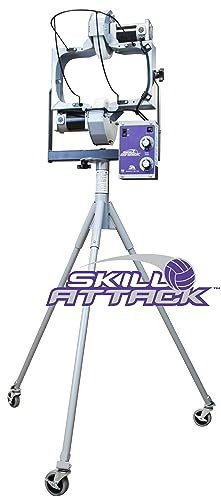
The Skill Attack is the entry point in the Sports Attack lineup. The powder-coated steel frame folds to 35x23x21 inches and weighs 58 pounds, fitting through standard doorways and loading into a car trunk without help. Two 5-inch throwing wheels run on 110V AC, and lockable non-marking casters make it easy to position on a gym floor without scratching the surface.
The release point sits at 5’3″ and speeds reach 40+ MPH, covering float serves and topspin at youth and high school heights. That speed ceiling will not replicate adult jump-serve intensity, but the machine handles serving, serve-receive, setting, and digging drills from a single setup. For a school program without a dedicated equipment room, the portability is the main practical draw.
If your players are primarily youth or high school athletes and you need a machine that travels in a regular car, this is the appropriate level in the Sports Attack lineup. Adult programs or taller players will need the Attack II or Attack (Men’s) to get a release point that matches their net height and speeds that challenge them.
| ✓ Pros | ✗ Cons |
|---|---|
| Folds to fit through a standard door and into a car trunk at 58 lbs | 40 MPH maximum cannot replicate adult jump-serve intensity |
| Handles serving, serve-receive, setting, and digging drills from one machine | Fixed 5’3″ release point limits usefulness for taller players |
| Most portable and transport-friendly option in the Sports Attack lineup | AC only, no battery option |
2. Attack Volleyball Training Machine (Men’s) – Best for Men’s Programs
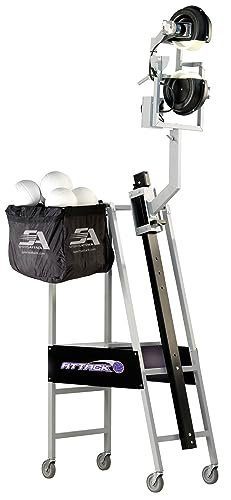
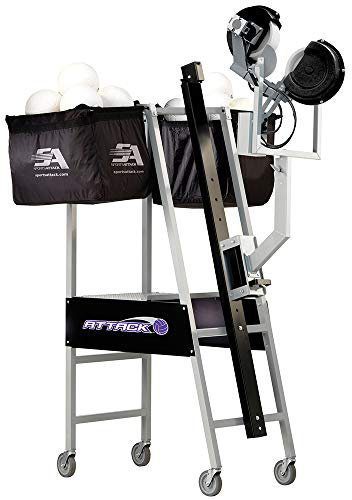
The Attack (Men’s) is Sports Attack’s serving machine built for men’s net height. The release point adjusts from 6′ to 9’3″, reaching above the men’s net, and speeds top out at 80+ MPH via two extra-wide 10-inch, 4-inch-wide throwing wheels. At 194.5 pounds and 24x83x50 inches, this is a permanent gym fixture. It ships with a heavy-duty 15-ball bag and a weatherproof cover, and is available in 110V or 220/240V models.
With an 80+ MPH ceiling and a release point that clears men’s net height, you can run realistic jump-serve reception and blocking drills that smaller machines cannot replicate. Ball direction is fully adjustable to any court position. The five-year limited warranty is the best coverage in this roundup by a wide margin.
This machine is for college, club, and adult programs running men’s or co-ed play. The size and weight mean it stays in the gym. If your program runs women’s games exclusively, the Attack II is calibrated for that net height and saves you the release-point range you would never use.
| ✓ Pros | ✗ Cons |
|---|---|
| Release point reaches 6′ to 9’3″, above men’s net height | Calibrated for men’s net height only, not suited for women’s-only programs |
| 80+ MPH replicates full jump-serve intensity for adult programs | 194.5 lbs requires a fixed gym location with a power outlet |
| Five-year limited warranty, best coverage in this roundup | No battery option |
3. Attack II Volleyball Machine (Women’s) – Best for Women’s Programs
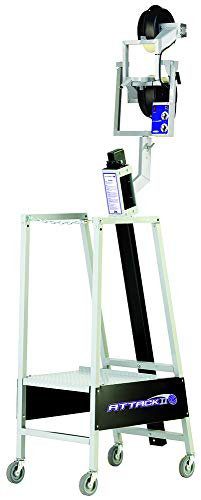
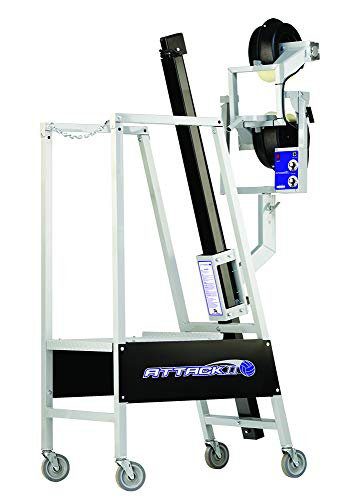
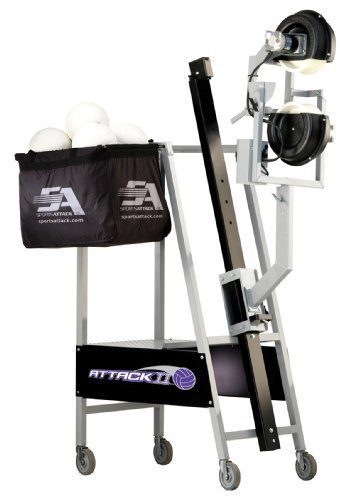
The Attack II is the same core design as the Attack (Men’s) but calibrated for women’s net height. The release point adjusts from 5’6″ to 8’6″, and speeds reach 70+ MPH from two 10-inch, 4-inch-wide throwing wheels. At 194.5 pounds it is a permanent gym fixture. Ball direction covers the full court. Ships with a ball bag and weatherproof cover in 110V or 220/240V configurations.
Thousands of college, high school, club, and international women’s programs use the Attack II daily for serve-receive, digging, and spiking reps. The 70+ MPH ceiling covers the full jump-serve range at the women’s level. Because the release point range stays below men’s net height, it is not the right fit for co-ed or men’s programs, but for women’s-only teams it matches the game exactly.
This is the recommended pick for coaches running a women’s or girls’ program who want a machine that handles the full range of practice drills without calibration trade-offs. For mixed programs where both net heights are needed, the Attack (Men’s) version reaches both.
| ✓ Pros | ✗ Cons |
|---|---|
| Release point 5’6″ to 8’6″ calibrated precisely for women’s net height | Release point does not reach men’s net height |
| 70+ MPH covers the full jump-serve range at the women’s level | Requires a power outlet, no battery option |
| Proven across thousands of college and club programs worldwide | 194.5 lbs needs dedicated gym storage space |
4. Volleyball Tutor Gold Model – Best Budget Auto-Feed
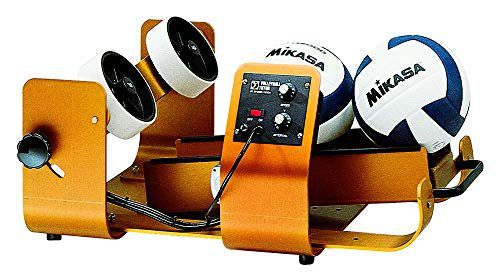
The Volleyball Tutor Gold is the most affordable route to auto-feed ball delivery. An extended ball track holds up to 6 balls and releases them at 5-to-20-second intervals, so no dedicated feeder is needed during drills. The machine weighs under 35 pounds and measures 29x22x13 inches, compact enough to store in a car trunk. It runs on AC power and carries a 3-year parts-and-labor warranty. Made in the USA.
Speed tops out at 60 MPH with floor-level delivery. That covers serve-receive, defensive digs, and setting drills but does not replicate above-net attack trajectories. An optional foot-operated remote (sold separately) lets you control ball feed from up to 40 feet away, keeping you close to your players while the machine runs. The AC power requirement means an extension cord is often needed in gym layouts.
The Gold is the right starting point for school teams, small clubs, or coaches who want a low-cost portable machine for basic repetition drills. If you need higher speed or an above-net release point, the Silver Pro or Black models step up on both counts without leaving the Sports Tutor lineup.
| ✓ Pros | ✗ Cons |
|---|---|
| Auto-feeds up to 6 balls at adjustable 5-20 second intervals with no feeder needed | Floor-level delivery only, no above-net release point |
| Under 35 lbs, genuinely fits in a car trunk | 60 MPH maximum is the lowest speed in the Tutor lineup |
| 3-year parts-and-labor warranty, Made in USA | AC only, extension cord often needed in gym settings |
5. Volleyball Tutor Silver Pro Model – Best Mid-Range Auto-Feed
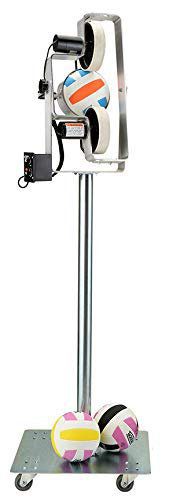
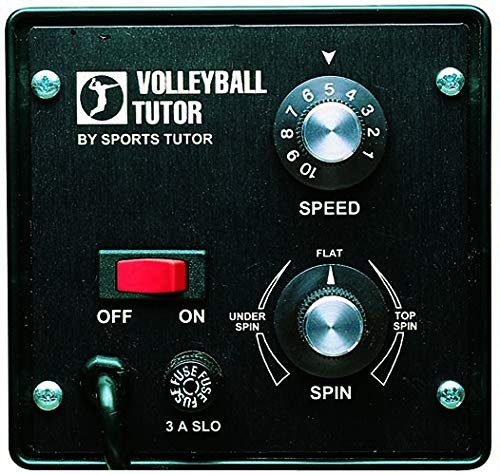
The Silver Pro sits between the Gold and Black in the Sports Tutor lineup. It delivers balls at up to 75 MPH from a high release point, with a topspin/underspin dial for spin control. Compared to the Gold’s 60 MPH floor-level delivery, that is a meaningful step up in serve speed and trajectory for competitive drill work. AC powered, 3-year parts-and-labor warranty, Made in USA.
The high release point makes the Silver Pro more useful for serve-receive and attacking drills than the floor-mounted Gold. The topspin/underspin control lets you vary spin type within a drill set without repositioning the machine, which adds variety to repetition training sessions. The published Amazon listing for this model has less detailed spec information than the Gold or Black pages, so contact Sports Tutor directly before purchasing if specific dimensions matter.
The Silver Pro suits programs that want an upgraded Tutor without paying the battery premium of the Black. If your gym has reliable outlets and you do not need to train in spaces without power, it gives you 75 MPH and spin control at a lower cost than the Black.
| ✓ Pros | ✗ Cons |
|---|---|
| 75 MPH from a high release point suits competitive serve-receive drills | AC powered, no battery option |
| Topspin/underspin dial adds spin variety without repositioning the machine | Amazon listing has less published spec detail than the Gold and Black models |
| 3-year parts-and-labor warranty, Made in USA | Costs more than the Gold without the battery portability of the Black |
6. Volleyball Tutor Black Model – Best Battery-Powered Machine
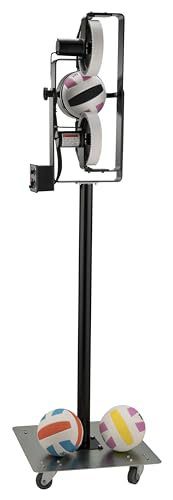
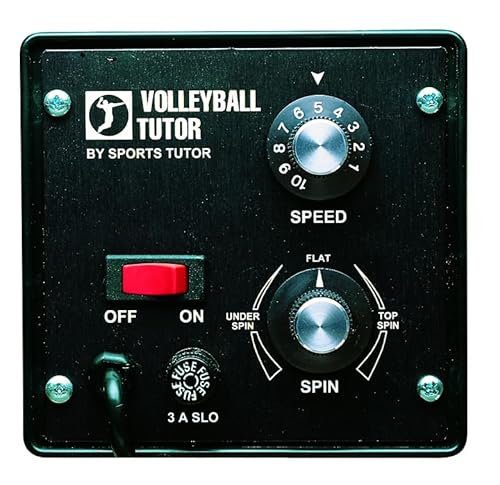
The Volleyball Tutor Black is the top Sports Tutor model and the only battery-powered machine in this roundup. The built-in rechargeable battery runs for several hours per charge, so you can train on outdoor courts, gym floors without nearby outlets, or any space where running a cord is impractical. Speeds reach 85 MPH from a high release point at 5.5 feet, making it the fastest Tutor model. Topspin/underspin dial included. Tool-free assembly, fits through a standard doorway. 3-year parts-and-labor warranty, Made in USA.
At 85 MPH the Black overlaps the lower end of the Sports Attack machines in raw speed, though the 5.5-foot release point does not reach men’s net height. The manual-feed design means someone still needs to load balls between reps, unlike the auto-feed Gold and Silver Pro models. For drill variety without a power outlet, no other machine in this post matches it.
The Black is the choice for coaches who train in multiple locations, including outdoor facilities, or for any program where running extension cords is a regular friction point. If you always train indoors with reliable outlets, the Silver Pro gives you similar speed at a lower cost. The battery premium is only worth paying if location flexibility is a real need for your setup.
| ✓ Pros | ✗ Cons |
|---|---|
| Battery-powered for several hours of training with no outlet required | Most expensive Sports Tutor model |
| 85 MPH is the fastest in the Sports Tutor lineup | Manual feed only, no auto-feed ball track |
| 3-year parts-and-labor warranty, Made in USA | Battery requires charging between long or back-to-back sessions |
7. Edge Pro Volleyball Trainer (Independent Model) – Best Spike Trainer
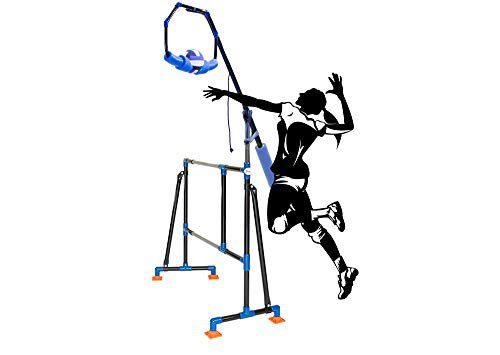
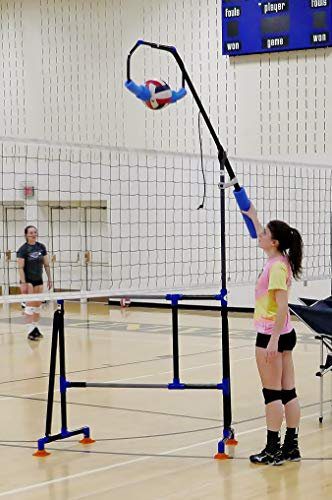
The Edge Pro Independent is a fundamentally different type of training machine. It holds the ball stationary in the hitting window at adjustable height, from 5′ to 9’4″ in 2-inch increments, covering youth through men’s net height without tools. Players approach, jump, and contact the ball exactly as they would in a game, then reset and repeat. No electricity and no ball delivery system needed.
The free-standing frame includes a regulation-height mini net for targeting. That targeting element turns solo mechanics work into a measurable drill: approach, contact, and clear the net. Players can log hundreds of approach-and-swing reps per session without a setter, a coach, or a gym. Spike mechanics improve faster from repeated reps at game height than from occasional live ball work where contact opportunities are sporadic.
The Independent Model suits programs that want a per-team spike trainer, or serious players training in a space large enough for a full approach. The larger footprint compared to the Travel/JV version is well suited to fixed gym use. If portability is your priority or you are buying for an individual player, the Travel/JV Pack below is the better fit.
| ✓ Pros | ✗ Cons |
|---|---|
| Height adjusts 5′ to 9’4″ in 2-inch increments, covering youth through men’s net | Static ball hold does not replicate a live ball’s game-speed trajectory |
| Included mini net adds a real targeting element to every approach rep | Pure mechanics trainer with no automated ball feed |
| No power or ball supply needed for complete spike mechanics sessions | Larger footprint than the Travel/JV version |
8. Edge Pro Volleyball Trainer (Travel/JV Pack) – Best for Solo Players
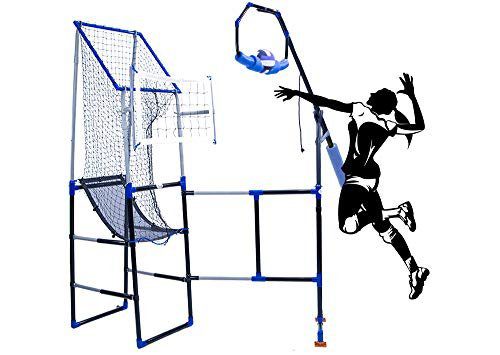
The Travel/JV Pack is the lighter, more packable version of the Edge Pro. It covers spike training at adjustable height and also includes an adjustable target stand for serve, setting, and passing mechanics, so it covers more individual skill areas than the Independent Model. No power required.
A player can load this into a bag, take it to an outdoor court, a park, or a backyard, and run a full mechanics session without a partner. The target stand adds serving and passing drills to the spike work, which means one piece of equipment covers three core individual skill areas. The lower price point makes spike mechanics training accessible to players who can’t justify the Independent Model’s cost.
The Travel/JV Pack is best suited to individual players, families of club athletes, or JV squads buying one per player rather than one per team. It is lighter and less stable than the free-standing Independent Model, so for team-level use in a fixed gym, the Independent version holds up better over time.